
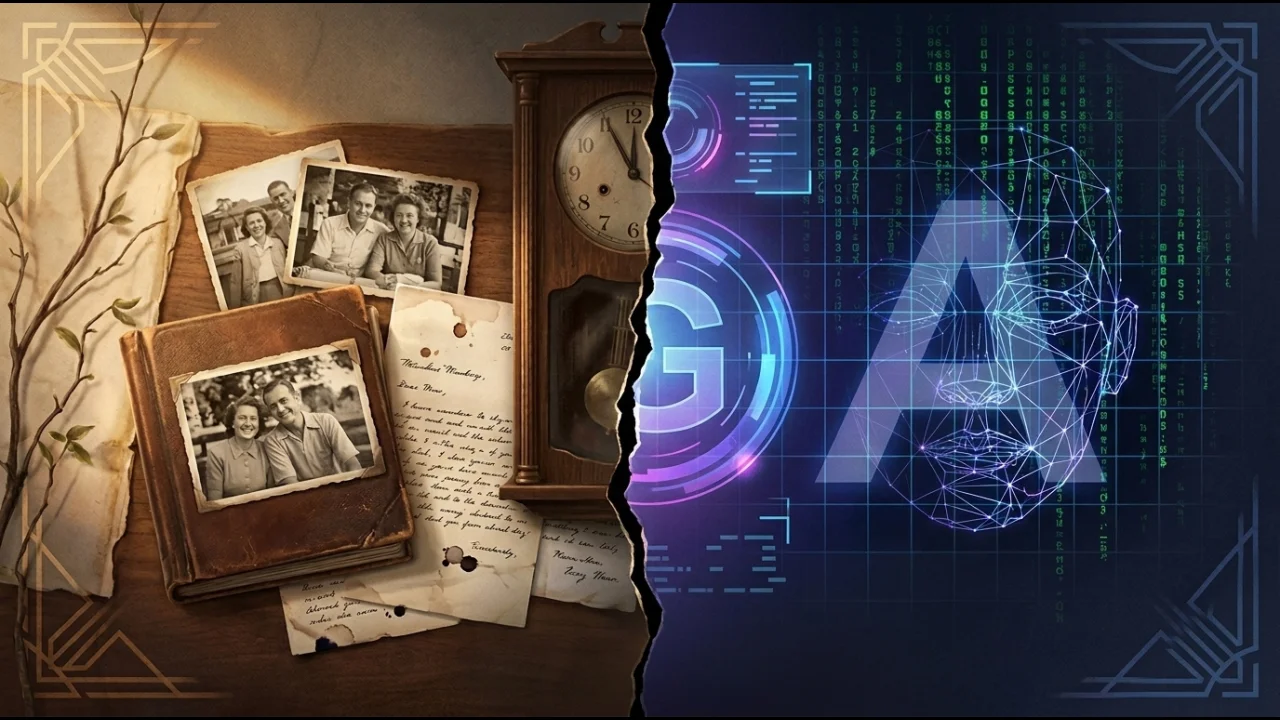
Grief Tech: When Memory Becomes a Simulation
Grief Tech explores how AI can simulate a person’s presence after death using their digital footprint. While this may feel comforting, it raises serious ethical questions about memory, identity, and the grieving process. Is it preservation - or imitation?
Imagine this: someone dies, but their account continues to respond to you in a messaging app.
The messages look familiar. The style is recognizable. The jokes are almost the same.
But it is no longer them.
In recent years, AI has come closer than ever to "extending" a person’s digital life. Algorithms analyze chats, posts, voice messages, and online behavior to maintain a profile after the owner is gone—sometimes even replying to friends and relatives.
This concept is often referred to as Grief Tech - technology built around loss and remembrance.
But with these possibilities comes a fundamental question:
Where is the line between preserving memory and creating a digital twin?
The Ethical Trap
Experts in psychology, ethics, and technology are increasingly raising concerns. It’s not just about the technology - it’s about the consequences.
The Illusion of Life
When a person leaves us, accepting the loss is a vital part of the healing process. If "they" continue to write, reply, and react, it creates an illusion of presence. This can stall or even disrupt the natural process of grieving.
Who Controls the Identity?
AI doesn’t "resurrect" a person; it only imitates behavior based on data. But who controls this imitation? Who is responsible for the words "they" might say after death? One wrong response could distort the memory of a person.
The Right to Be Forgotten
Not everyone wants to "live" on the internet indefinitely. We must ask: do we have the right to turn a human personality into a perpetual digital service?
The Alternative: A Conscious Digital Legacy
Instead of entrusting memory to algorithms, a different approach is emerging - one that is more honest and controlled.
Memorial Accounts
Many platforms already offer modes where a profile becomes an archive. It can be managed, but it never "speaks" on behalf of the deceased. This preserves history without simulating life.
Digital Archives
Photos, letters, videos, and stories can be gathered into a single space - not as a simulation, but as an authentic record of a life: what a person did, what they loved, and what they left behind.
Digital Inheritance
Passwords, access rights, and cloud storage are all part of modern life. It is better to decide in advance who will manage this data and how.
Why It Matters
Grief Tech is not just technology. It is where memory, emotion, and AI intersect. And it is easy to cross the line:
From preservation to replacement.
From memory to simulation.
From respect to exploitation.
Summary
Technology can preserve a person’s footprint, but it can never replace their presence. A digital twin is not a continuation of life - it is only an interpretation of it.
Memory works differently: it lives in people, in stories, and in real artifacts - not in algorithms trying to speak for those who are gone.
Memory is not an algorithm. And perhaps that is exactly what makes it real.